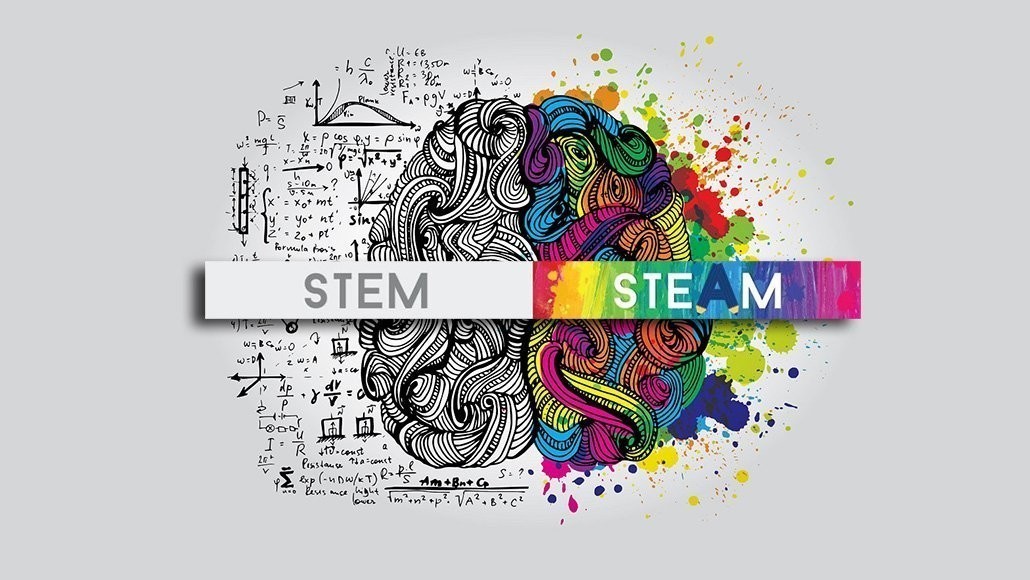
What is STEM Education?
STEM stands for:
- Science
- Technology
- Engineering
- Mathematics
It’s an interdisciplinary approach to learning where academic concepts are combined with real-world applications. Students learn how these subjects are integrated in real-life scenarios, encouraging problem-solving, critical thinking, and innovation.
What is STEAM Education?
STEAM includes everything in STEM plus the Arts:
- Science
- Technology
- Engineering
- Arts
- Mathematics
The inclusion of Arts (visual arts, language arts, design, music, humanities) promotes creativity, emotional expression, and design thinking alongside technical disciplines.
Core Objectives
| Feature | STEM | STEAM |
|---|---|---|
| Focus | Technical skills and scientific knowledge | Technical + Creative Thinking |
| Goal | Innovation through logic and reason | Innovation through logic and creativity |
| Method | Analytical, data-driven | Interdisciplinary, experiential, and expressive |
| Careers | Engineers, scientists, developers | Product designers, architects, UX designers, etc. |
Key Components of STEM/STEAM Education
- Project-Based Learning (PBL): Solving real-world problems.
- Inquiry-Based Learning: Students ask questions and conduct experiments.
- Collaboration: Group work to foster teamwork and communication.
- Integration Across Disciplines: Subjects taught in an interconnected way.
- Hands-On Learning: Use of lab experiments, robotics kits, coding, and prototyping.
Skills Developed
- Critical thinking & problem-solving
- Creativity and innovation
- Collaboration and teamwork
- Digital literacy
- Design thinking
- Entrepreneurial mindset
Implementation in Schools
- Elementary Level: Basic concepts via games, storytelling, and simple experiments.
- Middle School: More structured projects, coding, robotics, basic engineering.
- High School: Advanced coursework in physics, calculus, technology, and real-life simulations.
- Higher Education: Specializations in engineering, biotech, AI, design, and interdisciplinary innovation.
Global Perspective
- USA: Heavy federal and private investment; emphasis on innovation and technology.
- India: Focus on STEM through NEP 2020; STEAM rising through private ed-tech.
- China: Government-driven STEM focus with heavy tech industry integration.
- Finland & Scandinavian countries: Emphasis on interdisciplinary learning and creativity (STEAM).
- UK: Growing shift toward STEAM, with coding and design tech in curriculum.
Careers in STEM & STEAM
STEM Careers
- Data Scientist
- Mechanical Engineer
- Software Developer
- Civil Engineer
- Chemist
- Mathematician
STEAM Careers
- UX Designer
- Product Manager
- Industrial Designer
- Game Developer
- Biomedical Illustrator
- Digital Media Artist
Advantages
STEM
- Enhances logical and analytical skills.
- Prepares students for tech-driven jobs.
- Drives scientific research and innovation.
STEAM
- Builds empathy and communication.
- Encourages risk-taking and experimentation.
- Fosters holistic development and inclusive thinking.
Challenges
- Lack of trained educators in interdisciplinary methods.
- Resource gaps, especially in underfunded schools.
- Gender and diversity gaps in STEM fields.
- Over-standardized testing reduces creativity.
Transition from STEM to STEAM – Why It Matters
Many educators and researchers argue that real-world innovation comes not just from science and logic, but also from design, empathy, and creativity—traits associated with the arts. STEAM provides a more balanced approach, fostering both innovation and emotional intelligence.
Tools & Technologies Used
- Coding Platforms: Scratch, Python, Arduino
- Robotics Kits: LEGO Mindstorms, VEX, mBot
- Design Tools: Tinkercad, Canva, Adobe Suite
- Science Simulators: PhET, Gizmos
- 3D Printing: Makerspaces, CAD software
Example Activities
- Build a solar-powered car (STEM)
- Design a city using math and architectural drawing (STEAM)
- Code a video game (STEM)
- Create an interactive art installation using sensors (STEAM)
- Robotics competition (STEM)
- Wearable tech fashion show (STEAM)
Summary: STEM vs STEAM
| Feature | STEM | STEAM |
|---|---|---|
| Core Focus | Technical & Scientific Rigor | Innovation + Creativity |
| Disciplines | Science, Tech, Engg, Math | All STEM + Arts |
| Outcome | Engineers, Developers, Scientists | Designers, Thinkers, Innovators |
| Emphasis | Efficiency, Accuracy | Human-centered Design |
Further Reading & Resources
- STEM.org
- STEAM Education by the Rhode Island School of Design (RISD)
- Books:
- “STEM to STEAM: Using Brain-Compatible Strategies to Integrate the Arts” by David A. Sousa and Thomas J. Pilecki
- “Invent to Learn” by Sylvia Martinez & Gary Stager